Blog
Asia’s Battery Boom:
Why Smart BESS Integration Matters for Resilient Infrastructure
9 October 2025


This visual was created with artificial intelligence (AI) software.
Why Batteries Are Becoming Essential Infrastructure
Battery systems are no longer just a technical detail in power engineering — they’re rapidly becoming the backbone of resilient infrastructure. From hospitals to hyperscale data centres, from industrial parks to residential towers, Battery Energy Storage Systems (BESS) now play a central role in ensuring uptime, integrating renewable energy, and safeguarding operations.
By 2026, the Asia-Pacific region is expected to account for nearly 70% of the global BESS market, growing at a rate of 15–30% annually. Market value is projected to surge from US$4.5 billion in 2024 to nearly US$50 billion by 2034, with China, Singapore, and Southeast Asia at the forefront of adoption. (Asian Insiders)
The question is no longer if batteries will be adopted — but how to design and integrate them safely.
What Is a BESS and How Does It Work?
A Battery Energy Storage System isn’t just a giant battery pack. It’s an integrated system that:
- Charges – via Power Conversion System (PCS), rectifying AC from the grid or renewables into DC.
- Stores – cells monitored and balanced by a Battery Management System (BMS).
- Discharges – PCS inverts DC back to AC during outages, price spikes, or peak loads.
- Protects – BMS and safety devices detect faults, isolate risks, and trigger alarms.
This “charge–store–discharge–protect” cycle allows facilities to smooth energy use, improve reliability, and cut costs.
Lithium-Ion vs. Lead Acid: The Energy Shift
If you have ever replaced the battery in a car, old device, or solar setup, you have likely encountered lead-acid batteries. They are tried and true, but not exactly cutting-edge. Lithium-ion (Li-ion) batteries, on the other hand, are everywhere, from smartphones to Teslas to giant grid storage sites.
Lithium-ion (Li-ion): up to 5x energy density, faster charging, 10x longer lifespan in high-use scenarios .
Lead-acid: heavier, less efficient, shorter cycle life — though less prone to fire, they risk acid leakage and hydrogen gas buildup.
Li-ion is clearly the future. But with greater power comes greater responsibility: thermal runaway events (smoke, fire) have been reported globally when systems were poorly designed or operated.
That’s why system-level protection, not just cell-level safety, matters most.
BMS: The Silent Brain Behind Every Battery
Every modern large-scale battery depends on a Battery Management System (BMS) — the digital “safety officer” of the pack.
A BMS constantly:
- Protects – preventing overcharge, overheating, or short circuits.
- Preserves – balancing cells to extend lifespan and efficiency.
- Reports – providing accurate data on State of Charge (SOC) and State of Health (SOH).
Without a BMS, even the best Li-ion battery is a risk. Regulators and insurers increasingly require certified BMS controls before permitting commercial installations.
👉 In short: no BMS, no business case.
Fire Safety: The Defining Factor
Unlike a generator room, a BESS can face thermal runaway chain reactions, where heat and gas spread rapidly between cells.
Recent audits (CEA) found:
- 28% of systems had fire suppression gaps,
- 15% had thermal management issues.
Singapore responded in 2025 with stricter Fire Code updates (SCDF):
- Smoke detectors per SS 645
- Smoke purging systems activated on detection
- Compartmentalised ESS rooms
Other regions — US, UK, Australia — are also tightening rules after recent ESS fires.
This isn’t just compliance — it’s survival. Without smart fire protection, insurers may deny coverage, and operators face costly downtime.
👉 Related Reading: Smart Safety Systems for Data Centres: Prevent Downtime
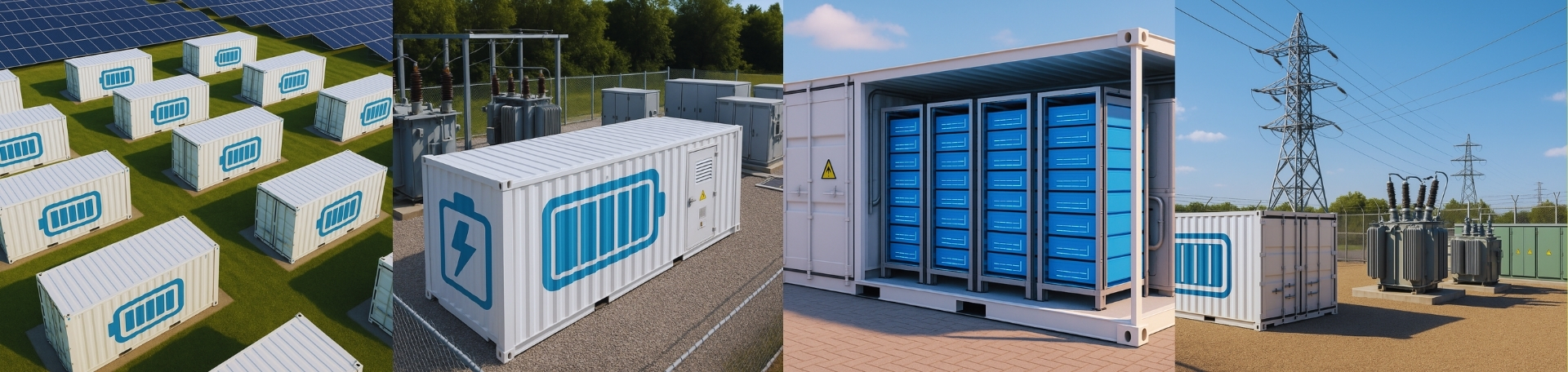
This visual was created with artificial intelligence (AI) software.
Market Momentum and What It Means for You
The global Battery Energy Storage System (BESS) market shows no signs of slowing down. By 2034, it is forecast to reach US$320 billion, driven by the urgent need for energy security, the integration of renewable energy, and grid resilience. Businesses that have already adopted commercial-scale systems are seeing significant returns. In some cases, operators are reporting up to 30% savings on electricity bills by storing cheaper off-peak or solar-generated energy and deploying it during peak demand periods.
Southeast Asia is rapidly catching up with this global momentum. Singapore has moved ahead by mandating BESS in particular critical infrastructure projects, recognising its role in grid stability and backup power. Meanwhile, countries like Indonesia and Vietnam are investing heavily in large-scale deployments, with projects that aim to strengthen local grids and attract data centre and industrial investment. This regional acceleration underscores one reality: BESS is shifting from a “nice-to-have” to a core requirement in modern power planning.
What to watch:
- Integration with existing power systems
- Ventilation and placement in space-constrained facilities
- Compliance with latest codes and insurer requirements
- Ongoing monitoring and maintenance
The Power Partners Perspective
At Power Partners, we see BESS as more than a technology trend. It’s the foundation of resilient power strategy in Asia.
Our engineers help businesses and facility owners:
- Design right-sized systems for unique site constraints
- Integrate BESS with generators, DRUPS, and renewables
- Implement smart monitoring, fire suppression, and compliance-ready design
Because at the end of the day, it’s not about “buying batteries.”
It’s about building resilience.
Key Takeaways
- Asia leads the battery boom — growth is explosive, but design matters.
- Li-ion with smart BMS is the standard, not the option.
- Fire safety and compliance are now deal-breakers for insurers and regulators.
- The right integration partner ensures your system is safe, scalable, and future-ready.
👉 Ready to explore BESS for your facility? Talk to Power Partners today.
This visual was created with artificial intelligence (AI) software.
What Decision-Makers Ask About BESS
Q: Are lithium-ion batteries safe for large-scale use?
Yes — when combined with a smart BMS, proper cooling, and certified fire suppression. Poorly designed systems pose risks.
Q: Why is fire safety so critical in BESS?
Thermal runaway can escalate quickly. New codes (e.g., Singapore 2025 Fire Code) mandate stricter safety measures.
Q: What’s the ROI of installing a BESS?
Businesses can save up to 30% on energy costs, while gaining resilience and meeting regulatory demands.
Q: How do BESS integrate with existing power systems?
Modern BESS are designed to work alongside generators, DRUPS, and renewables. With the right PCS and EMS setup, they can provide peak shaving, backup support, and seamless switchover during outages.
Q: What are the space and ventilation requirements for BESS?
Because batteries generate heat and gases, dedicated compartments with smoke detection, ventilation, and fire-rated separation are essential — especially in dense urban or data centre environments.
Q: Who should oversee the operation and maintenance of a BESS?
Certified engineers or facility teams trained in BESS monitoring should handle daily oversight. Many operators now use remote monitoring and predictive maintenance to ensure performance and reduce downtime risks.